
Gold slips ahead of US PCE as US Dollar firms modestly
- Gold edges lower as traders reduce exposure ahead of the US PCE inflation report.
- Markets see a 64% chance that the Fed will hold interest rates steady in September.
- XAU/USD maintains a bullish technical bias above the 50-, 100- and 200-day SMAs.
Gold (XAU/USD) edges lower on Wednesday as buyers trim their exposure ahead of the US Personal Consumption Expenditures (PCE) Price Index data, due at 12:30 GMT. At the time of writing, XAU/USD trades around $4,615 after reaching $4,697 on Tuesday, its highest since May 14.
The Federal Reserve’s (Fed) preferred inflation gauge is expected to show headline PCE inflation easing to 3.6% YoY in July from 3.7% in June, while core PCE inflation is forecast to hold steady at 3.3% during the same period. On a monthly basis, the headline index is forecast to rise 0.1%, following a 0.1% decline in June, while the core reading is expected to increase 0.2%, up from 0.1%.
The data will be closely watched and could determine whether Gold resumes its recovery or loses momentum. Another soft inflation report, following the July Consumer Price Index (CPI) and Producer Price Index (PPI) figures, could encourage traders to scale back expectations of a Fed interest rate hike at its upcoming meeting. As a non-yielding asset, Gold generally performs better when interest rates are low.
According to the CME FedWatch Tool, markets are currently pricing in a 64% chance that the central bank will leave borrowing costs unchanged at its September meeting.
Alongside the PCE report, traders will also monitor the preliminary estimate of second-quarter US Gross Domestic Product (GDP), Durable Goods Orders and Personal Income and Spending figures.
Meanwhile, the US Dollar (USD) firms modestly on Wednesday, weighing on Dollar-denominated Gold. The US Dollar Index (DXY), which tracks the Greenback's value against a basket of six major currencies, trades around 99.00, up roughly 0.12% on the day.
However, the US Dollar remains pinned near its recent lows after last week’s sell-off. The US Treasury’s decision to increase buybacks of longer-dated government securities has revived concerns about rising US debt and fiscal credibility. The return of the currency-debasement narrative has renewed demand for Gold.
On the geopolitical front, Iranian Deputy Foreign Minister Kazem Gharibabadi stressed that the temporary transit deal with Oman does not mean the Strait of Hormuz has reopened. He said the waterway will stay closed until the United States fulfils its commitments under the Memorandum of Understanding (MOU). Even so, markets have taken the agreement as a positive step, with West Texas Intermediate (WTI) Oil falling for a third consecutive day and trading around $80.00 per barrel.
Technical analysis: XAU/USD bullish bias intact, RSI signals stretched momentum
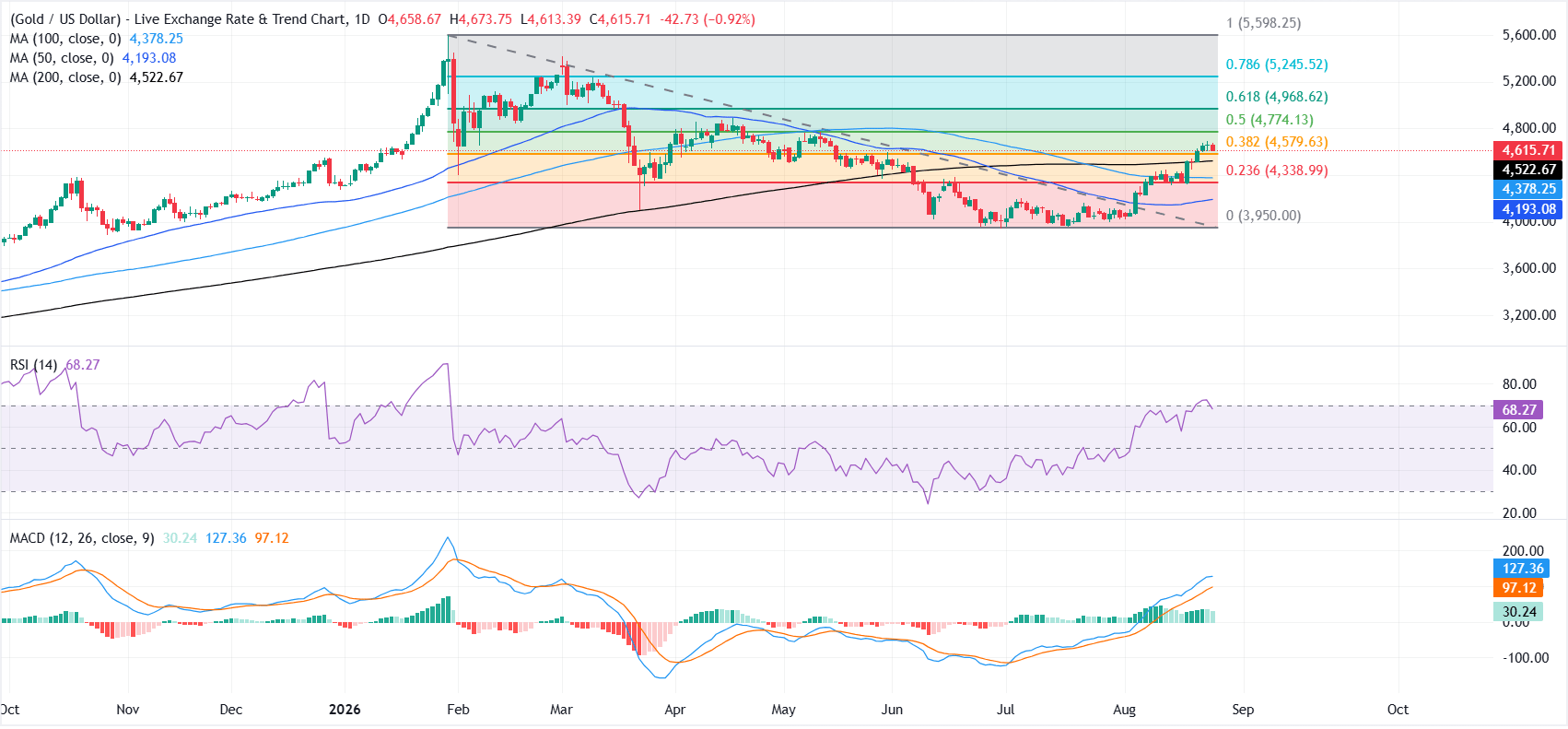
On the daily chart, XAU/USD maintains a bullish bias above the 50-, 100- and 200-day Simple Moving Averages (SMAs). However, the Relative Strength Index (RSI) near 68 suggests buyers may be hesitant to chase the metal higher at current levels. The Moving Average Convergence Divergence (MACD) remains in positive territory, keeping the broader momentum tilted to the upside.
On the topside, initial resistance is seen at the 50.0% Fibonacci retracement at $4,774, followed by the 61.8% level at $4,968. A sustained break above these levels could expose the 78.6% Fibonacci retracement level at $5,245 and the all-time high of $5,598.25.
On the downside, immediate support is located at the 38.2% Fibonacci retracement at $4,579, followed by the 200-day SMA at $4,522 and the 100-day SMA at $4,378. A deeper pullback could bring the 23.6% retracement at $4,338 and the 50-day SMA near $4,193 into focus.
(The technical analysis of this story was written with the help of an AI tool. Know more.)
Inflation FAQs
Inflation measures the rise in the price of a representative basket of goods and services. Headline inflation is usually expressed as a percentage change on a month-on-month (MoM) and year-on-year (YoY) basis. Core inflation excludes more volatile elements such as food and fuel which can fluctuate because of geopolitical and seasonal factors. Core inflation is the figure economists focus on and is the level targeted by central banks, which are mandated to keep inflation at a manageable level, usually around 2%.
The Consumer Price Index (CPI) measures the change in prices of a basket of goods and services over a period of time. It is usually expressed as a percentage change on a month-on-month (MoM) and year-on-year (YoY) basis. Core CPI is the figure targeted by central banks as it excludes volatile food and fuel inputs. When Core CPI rises above 2% it usually results in higher interest rates and vice versa when it falls below 2%. Since higher interest rates are positive for a currency, higher inflation usually results in a stronger currency. The opposite is true when inflation falls.
Although it may seem counter-intuitive, high inflation in a country pushes up the value of its currency and vice versa for lower inflation. This is because the central bank will normally raise interest rates to combat the higher inflation, which attract more global capital inflows from investors looking for a lucrative place to park their money.
Formerly, Gold was the asset investors turned to in times of high inflation because it preserved its value, and whilst investors will often still buy Gold for its safe-haven properties in times of extreme market turmoil, this is not the case most of the time. This is because when inflation is high, central banks will put up interest rates to combat it. Higher interest rates are negative for Gold because they increase the opportunity-cost of holding Gold vis-a-vis an interest-bearing asset or placing the money in a cash deposit account. On the flipside, lower inflation tends to be positive for Gold as it brings interest rates down, making the bright metal a more viable investment alternative.