
Gold steadies on Iran diplomacy hopes, Fed outlook caps upside
- Gold recovers from its intraday low as traders react to Iran’s proposal on reopening the Strait of Hormuz.
- Hawkish Federal Reserve expectations continue to cap the metal’s upside.
- Technically, XAU/USD remains trapped between the 50- and 100-day SMAs and the 200-day SMA.
Gold (XAU/USD) halts its intraday decline on Tuesday as traders weigh fresh Middle East headlines while the broader geopolitical backdrop remains tense. At the time of writing, XAU/USD trades around $4,315, after bouncing from a low of $4,291 during European trading hours.
Iran has offered to reopen the Strait of Hormuz within seven days if the United States (US) lifts its blockade of Iranian ports and eases military pressure, Kyodo News reported earlier on Tuesday, citing a senior Iranian official. The proposal has reportedly already been conveyed to Washington through mediators.
Following the development, the US Dollar (USD) reverses its earlier gains, helping Gold regain some ground, while Oil prices extend their decline for a fifth straight day. The US Dollar Index (DXY), which tracks the Greenback's value against a basket of six major currencies, trades around 100.40 after retreating from an intraday high of 100.67, its highest level since July 30. Meanwhile, West Texas Intermediate (WTI) Oil trades near $89.50 and is down more than 5% so far this week.
Still, tensions remain high after the US and Iran traded fresh threats of further military action over the weekend. Attention now turns to the UN General Assembly later on Tuesday, where US President Donald Trump has left the door open to meeting Iranian President Masoud Pezeshkian, though no talks are confirmed. Trump is also due to meet leaders from several Gulf nations.
For Gold, however, the main headwind remains the hawkish Federal Reserve (Fed) policy outlook, which could limit a stronger recovery unless the Strait of Hormuz reopens and triggers a meaningful decline in Oil prices and inflation concerns. As a non-yielding asset, Gold tends to struggle when borrowing costs rise.
The Fed delivered its first interest-rate hike in three years last week, raising the federal funds rate by 25 basis points to 3.75%-4.00% as policymakers responded to stubborn inflation and elevated energy prices. 16 of 18 officials expect at least one more increase this year.
Brown Brothers Harriman notes that Fed communication remains firmly tilted toward further tightening, with some members indicating that “more tightening is in the pipeline.” The bank highlights comments from St. Louis Fed President Alberto Musalem, who argued that additional rate hikes may be needed to curb inflation, while Chicago Fed President Austan Goolsbee cautioned that policy could become “more aggressive and more and more front-loaded” if demand is seen overheating.
BBH adds that the hawkish tone may be reinforced or nuanced later today, as “more Fed officials speak,” including New York Fed President John Williams, Fed Vice Chair Philip Jefferson, and Richmond Fed President Tom Barkin.
Technical analysis: XAU/USD steadies above 50-day and 100-day SMAs
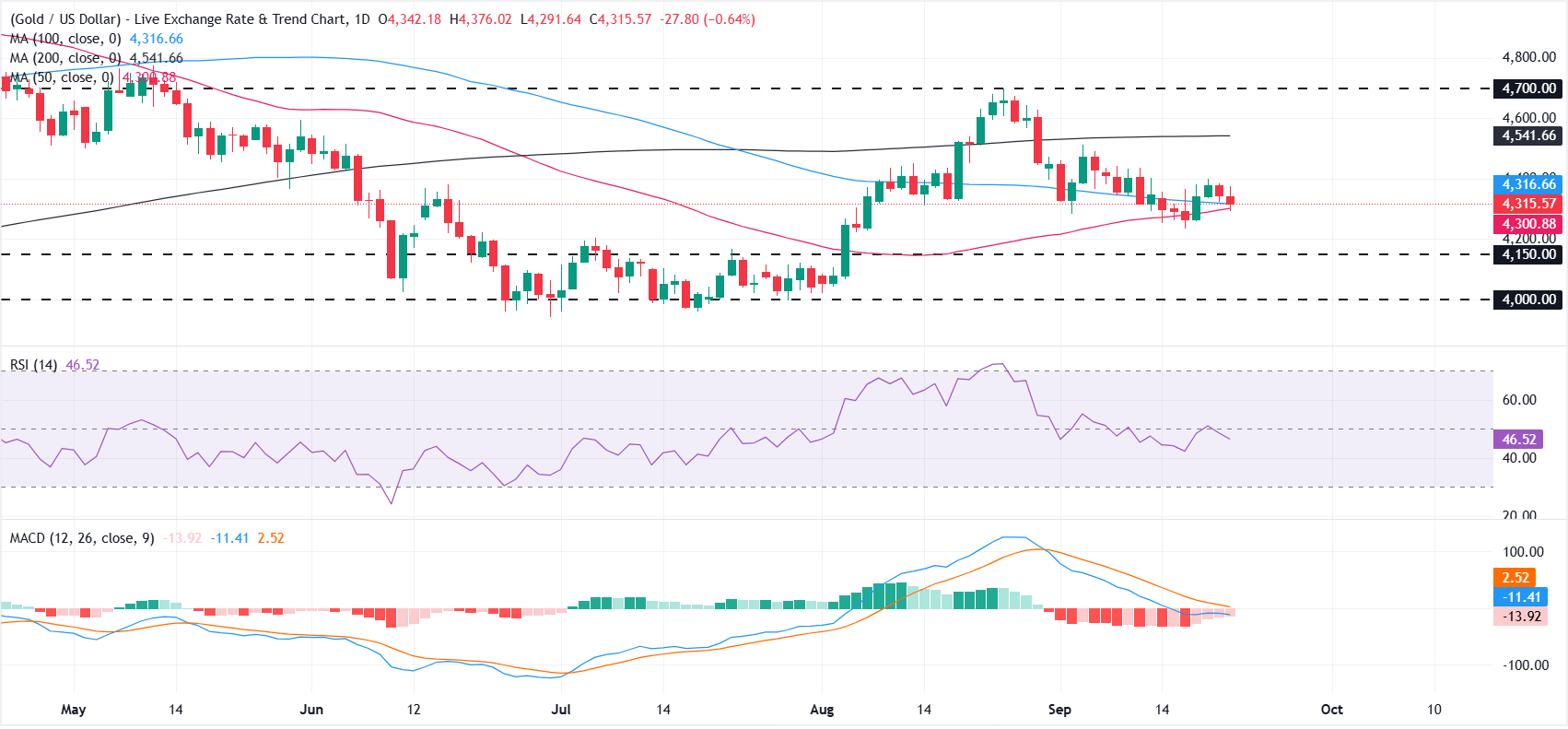
On the daily chart, XAU/USD holds above the 50-day and 100-day Simple Moving Averages (SMAs) at $4,301 and $4,316, respectively, while remaining below the 200-day SMA at $4,541. This setup keeps the near-term bias broadly neutral, with Gold caught between nearby trend support and longer-term resistance.
Momentum indicators also point to a range-bound setup. The Relative Strength Index (RSI) at 47 stays close to the neutral 50 mark, while the Moving Average Convergence Divergence (MACD) remains in negative territory. However, the fading red histogram bars suggest bearish momentum is losing strength.
On the downside, the 100-day SMA at $4,316 and the 50-day SMA at $4,301 form a key support zone. A break below this area could expose $4,150 and the psychological $4,000 mark.
On the topside, the 200-day SMA at $4,541 acts as the key resistance, followed by the $4,700 level. A sustained break above these barriers would be needed to strengthen the bullish outlook.
(The technical analysis of this story was written with the help of an AI tool. Know more.)
Gold FAQs
Gold has played a key role in human’s history as it has been widely used as a store of value and medium of exchange. Currently, apart from its shine and usage for jewelry, the precious metal is widely seen as a safe-haven asset, meaning that it is considered a good investment during turbulent times. Gold is also widely seen as a hedge against inflation and against depreciating currencies as it doesn’t rely on any specific issuer or government.
Central banks are the biggest Gold holders. In their aim to support their currencies in turbulent times, central banks tend to diversify their reserves and buy Gold to improve the perceived strength of the economy and the currency. High Gold reserves can be a source of trust for a country’s solvency. Central banks added 1,136 tonnes of Gold worth around $70 billion to their reserves in 2022, according to data from the World Gold Council. This is the highest yearly purchase since records began. Central banks from emerging economies such as China, India and Turkey are quickly increasing their Gold reserves.
Gold has an inverse correlation with the US Dollar and US Treasuries, which are both major reserve and safe-haven assets. When the Dollar depreciates, Gold tends to rise, enabling investors and central banks to diversify their assets in turbulent times. Gold is also inversely correlated with risk assets. A rally in the stock market tends to weaken Gold price, while sell-offs in riskier markets tend to favor the precious metal.
The price can move due to a wide range of factors. Geopolitical instability or fears of a deep recession can quickly make Gold price escalate due to its safe-haven status. As a yield-less asset, Gold tends to rise with lower interest rates, while higher cost of money usually weighs down on the yellow metal. Still, most moves depend on how the US Dollar (USD) behaves as the asset is priced in dollars (XAU/USD). A strong Dollar tends to keep the price of Gold controlled, whereas a weaker Dollar is likely to push Gold prices up.