
Euro recovers further against US Dollar amid AI sell-off narrative
- Euro strengthens against the US Dollar, recovery intensifies to near 1.1250.
- The AI sell-off narrative in global markets keeps the US Dollar under pressure.
- Fed Chair Warsh signals that the central bank is committed to achieving price stability.
The Euro (EUR) extends its recovery move to near 1.1250 against the US Dollar (USD) in the European trading session on Friday. The major currency pair started recovering after posting a fresh 16-month low near 1.1113 on Wednesday. The EUR/USD pair bounced back as the US Dollar retreated from its yearly high due to Artificial Intelligence (AI) sell-off narrative in global markets.
US Dollar Price Today
The table below shows the percentage change of US Dollar (USD) against listed major currencies today. US Dollar was the weakest against the New Zealand Dollar.
| USD | EUR | GBP | JPY | CAD | AUD | NZD | CHF | |
|---|---|---|---|---|---|---|---|---|
| USD | -0.30% | -0.44% | -0.02% | -0.19% | -0.58% | -0.85% | -0.39% | |
| EUR | 0.30% | -0.15% | 0.25% | 0.09% | -0.26% | -0.56% | -0.10% | |
| GBP | 0.44% | 0.15% | 0.42% | 0.29% | -0.13% | -0.40% | 0.05% | |
| JPY | 0.02% | -0.25% | -0.42% | -0.14% | -0.53% | -0.78% | -0.35% | |
| CAD | 0.19% | -0.09% | -0.29% | 0.14% | -0.37% | -0.71% | -0.21% | |
| AUD | 0.58% | 0.26% | 0.13% | 0.53% | 0.37% | -0.28% | 0.19% | |
| NZD | 0.85% | 0.56% | 0.40% | 0.78% | 0.71% | 0.28% | 0.48% | |
| CHF | 0.39% | 0.10% | -0.05% | 0.35% | 0.21% | -0.19% | -0.48% |
The heat map shows percentage changes of major currencies against each other. The base currency is picked from the left column, while the quote currency is picked from the top row. For example, if you pick the US Dollar from the left column and move along the horizontal line to the Japanese Yen, the percentage change displayed in the box will represent USD (base)/JPY (quote).
In the European trade, the US Dollar Index (DXY), which gauges the Greenback’s value against six major currencies, revisits the six-week low near 101.67.
Dollar’s AI tailwind seen as emerging vulnerability in US-centric risk-off shocks
Strategists at OCBC highlight that AI-linked investment has become a key support for the US macro and market story, noting that “AI has supported US growth, equities, yields and the USD.” However, they caution that “that strength cuts both ways.” If the investment cycle cools, “those same supports could reverse, leaving the Dollar vulnerable even in a risk-off environment.”
OCBC stresses that “the USD does not always benefit from risk aversion.” When the shock is US-centric, “as with the recent AI financing jitters, pressure on US assets can overwhelm the USD’s traditional safe-haven appeal.” This is significant, they argue, because “AI has become an important pillar of US growth resilience.”
In FX terms, OCBC describes “an unusual combination: risk-off, lower Treasury yields and a softer USD.” They emphasise that “this is not the typical global risk-off shock where investors simply rush into USD.” Instead, “if the source of stress is US-centric, Treasury safe-haven demand can push yields lower even as weaker US asset returns reduce the relative appeal of the USD.”
For now, OCBC views “the latest AI jitters as a bump rather than a break in the broader investment story.” While “concerns look overdone, but they are far from over,” the episode is seen as “a useful reminder for FX.” As they conclude, “the more the USD benefits from AI-driven US growth resilience on the way up, the more exposed it becomes if that support starts to fade.”
On the monetary policy front, Federal Reserve (Fed) Chair Kevin Warsh continue to avoid delivering remarks on the monetary policy outlook, but assures that price stability is key motive.
Warsh cautious on crisis scars but highlights investment surge and AI, keeping Dollar focus on upcoming FOMC meetings
Fed Chair Warsh’s speech scores 5.6/10 on the FXS Speechtracker, modestly below the 6.1/10 historical average, signaling a slightly less impactful but still policy-relevant appearance. The admission of being “over-scarred from the global financial crisis” underscores a structurally cautious bias even as Warsh points to structural growth and an investment surge, suggesting a reluctance to pre-commit on rates despite a constructive macro backdrop. Warsh’s emphasis on AI, data confidence, and upcoming field hearings reinforces a forward-looking stance, but the repeated refusal to prejudge meetings keeps Dollar traders focused on the October and December FOMC “crystallizing” decisions rather than this speech alone.
The FXS Fed Sentiment Index was unchanged, moving 0.00 points to a still-elevated level of 127.51, confirming that the overall policy tone remains firmly in hawkish territory despite the slightly softer speech score relative to the historical average. The combination of a high FXS Fed Sentiment Index level and a middling FXS Speechtracker score suggests that Warsh’s remarks neither escalated nor diluted the prevailing hawkish bias, leaving Dollar positioning anchored to expectations for upcoming FOMC outcomes.
EUR/USD Technical Analysis
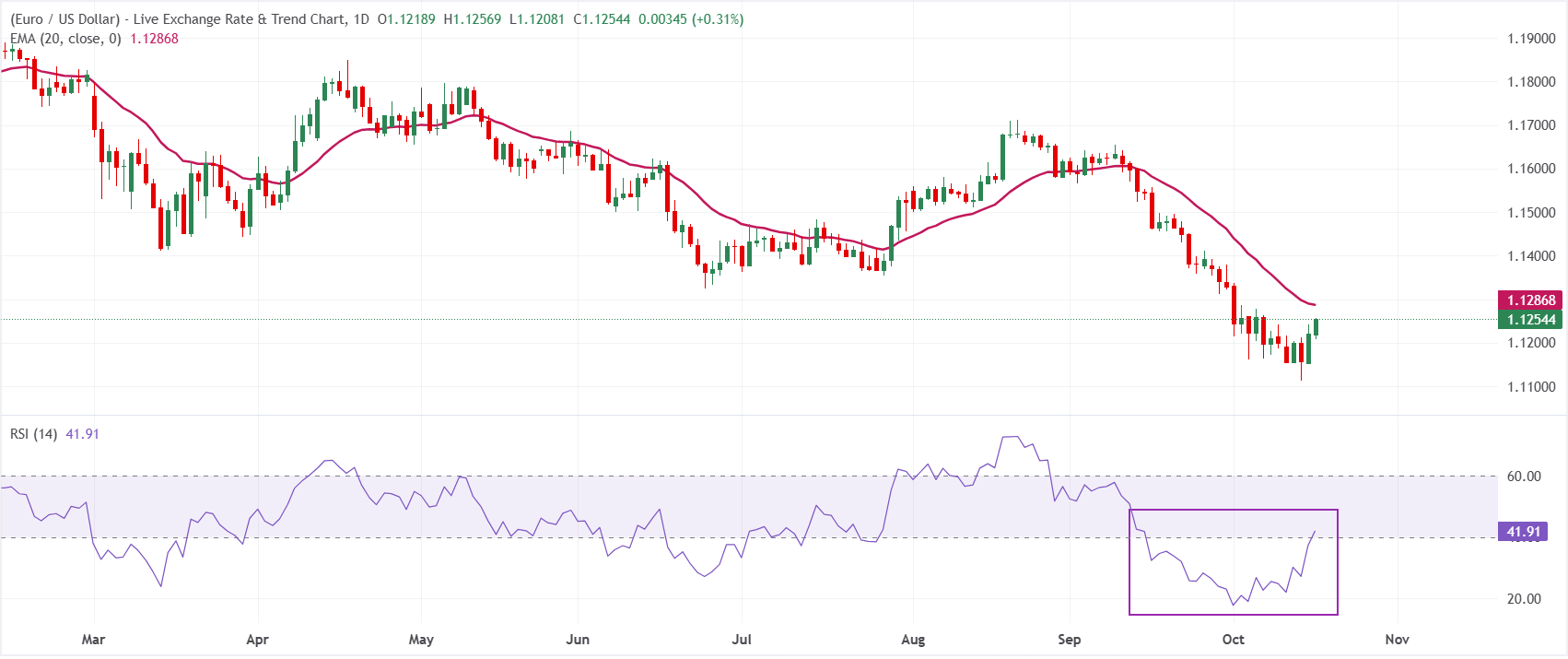
In the daily chart, EUR/USD trades at 1.1254, keeping a bearish near-term tone as it remains capped by the 20-day exponential moving average (EMA) at 1.1287 overhead. The pair is struggling to reclaim this dynamic barrier, while the Relative Strength Index (14) at 41.9 stays below neutral, suggesting only modest recovery potential at this stage.
On the topside, immediate resistance is located at the 20-day EMA at 1.1287, and a sustained break above this level would be needed to ease downside pressure and allow a more meaningful rebound. On the downside, with no nearby technical supports in the dataset below the market, sellers could attempt to push the pair toward fresh lows, keeping the broader bias tilted to the downside unless price decisively moves above the mentioned moving average.
(The technical analysis of this story was written with the help of an AI tool. Know more.)
US Dollar FAQs
The US Dollar (USD) is the official currency of the United States of America, and the ‘de facto’ currency of a significant number of other countries where it is found in circulation alongside local notes. It is the most heavily traded currency in the world, accounting for over 88% of all global foreign exchange turnover, or an average of $6.6 trillion in transactions per day, according to data from 2022. Following the second world war, the USD took over from the British Pound as the world’s reserve currency. For most of its history, the US Dollar was backed by Gold, until the Bretton Woods Agreement in 1971 when the Gold Standard went away.
The most important single factor impacting on the value of the US Dollar is monetary policy, which is shaped by the Federal Reserve (Fed). The Fed has two mandates: to achieve price stability (control inflation) and foster full employment. Its primary tool to achieve these two goals is by adjusting interest rates. When prices are rising too quickly and inflation is above the Fed’s 2% target, the Fed will raise rates, which helps the USD value. When inflation falls below 2% or the Unemployment Rate is too high, the Fed may lower interest rates, which weighs on the Greenback.
In extreme situations, the Federal Reserve can also print more Dollars and enact quantitative easing (QE). QE is the process by which the Fed substantially increases the flow of credit in a stuck financial system. It is a non-standard policy measure used when credit has dried up because banks will not lend to each other (out of the fear of counterparty default). It is a last resort when simply lowering interest rates is unlikely to achieve the necessary result. It was the Fed’s weapon of choice to combat the credit crunch that occurred during the Great Financial Crisis in 2008. It involves the Fed printing more Dollars and using them to buy US government bonds predominantly from financial institutions. QE usually leads to a weaker US Dollar.
Quantitative tightening (QT) is the reverse process whereby the Federal Reserve stops buying bonds from financial institutions and does not reinvest the principal from the bonds it holds maturing in new purchases. It is usually positive for the US Dollar.